Story One
Amara & Derek
VBAC attempt · 38 weeks · High-risk designation
The Situation
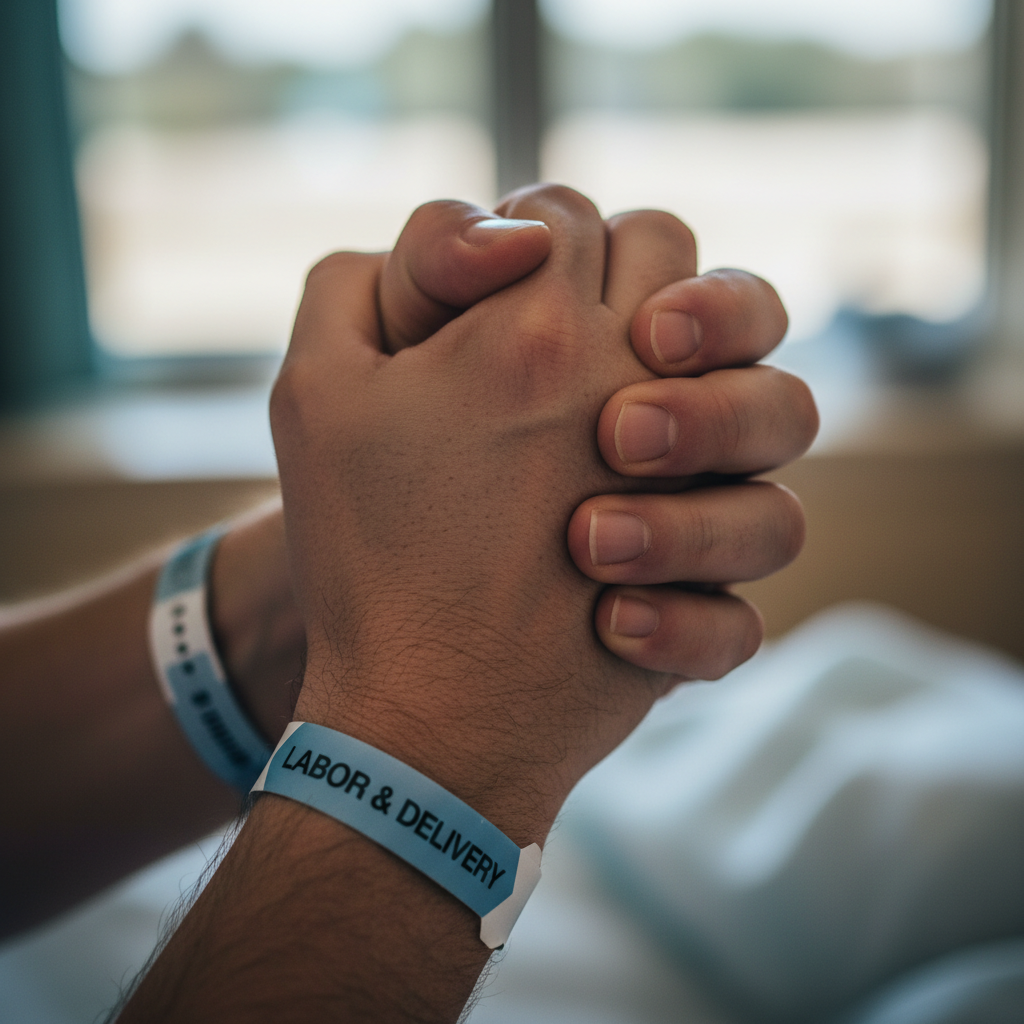
Amara's first birth ended in an emergency cesarean after 22 hours of labor that stalled at 7 centimeters. She came to us eight months pregnant with her second, carrying a thick medical file and a fear she couldn't quite name. Her OB had cleared her for a VBAC attempt but flagged the pregnancy as high-risk. Derek had been her rock the first time — steady, present, completely lost. He didn't know what to do with his hands. He didn't know where to stand. He told us in our first call: "I just need someone to tell me how to actually help her."
The Birth Plan
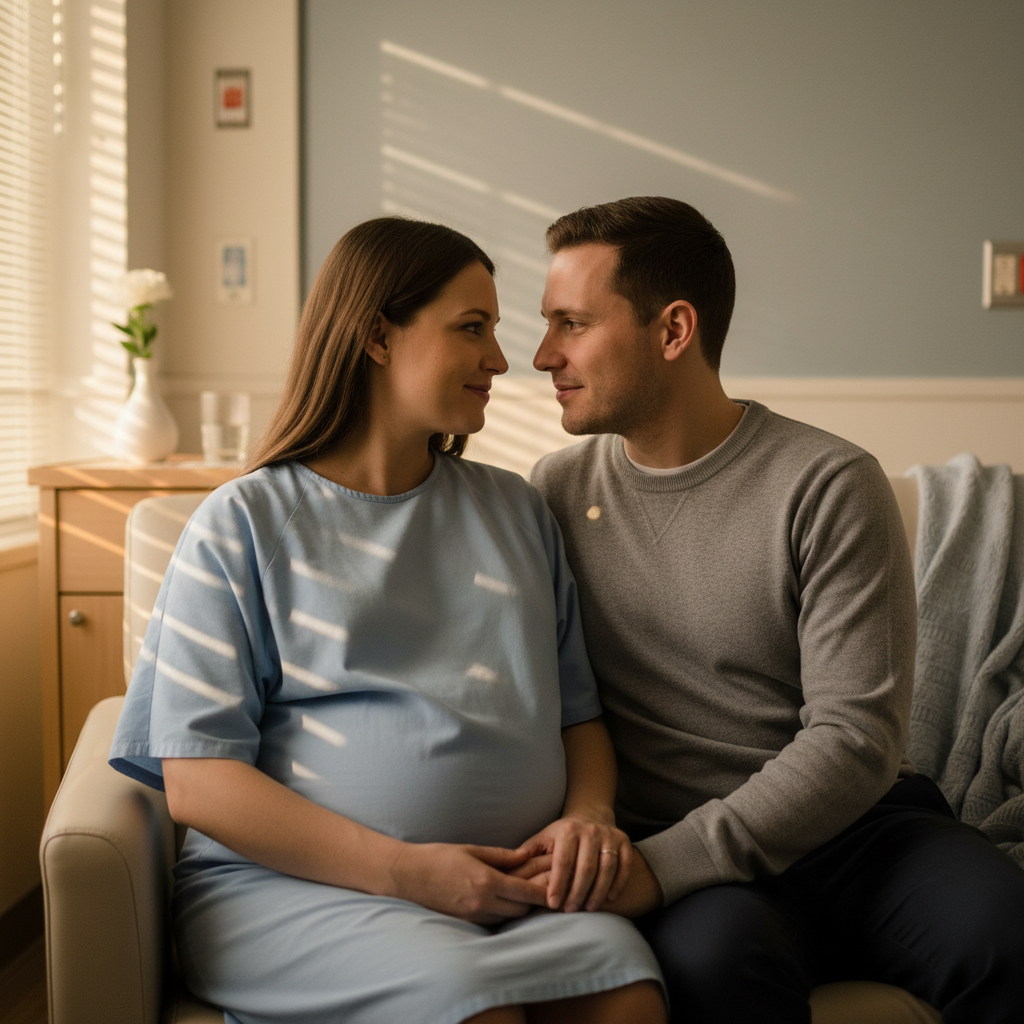
We spent two sessions building a plan that wasn't a wishlist — it was a decision tree. If labor stalls again, here are the three questions to ask before agreeing to anything. If the monitor shows this, here's what it means and what you can request. Derek got his own sheet: hand positions for back labor, when to apply counter-pressure and exactly how much, what to say when Amara says she can't do this anymore. We rehearsed it. He practiced on a doorframe. By the time they left our third session, he looked like a different person.
The Labor
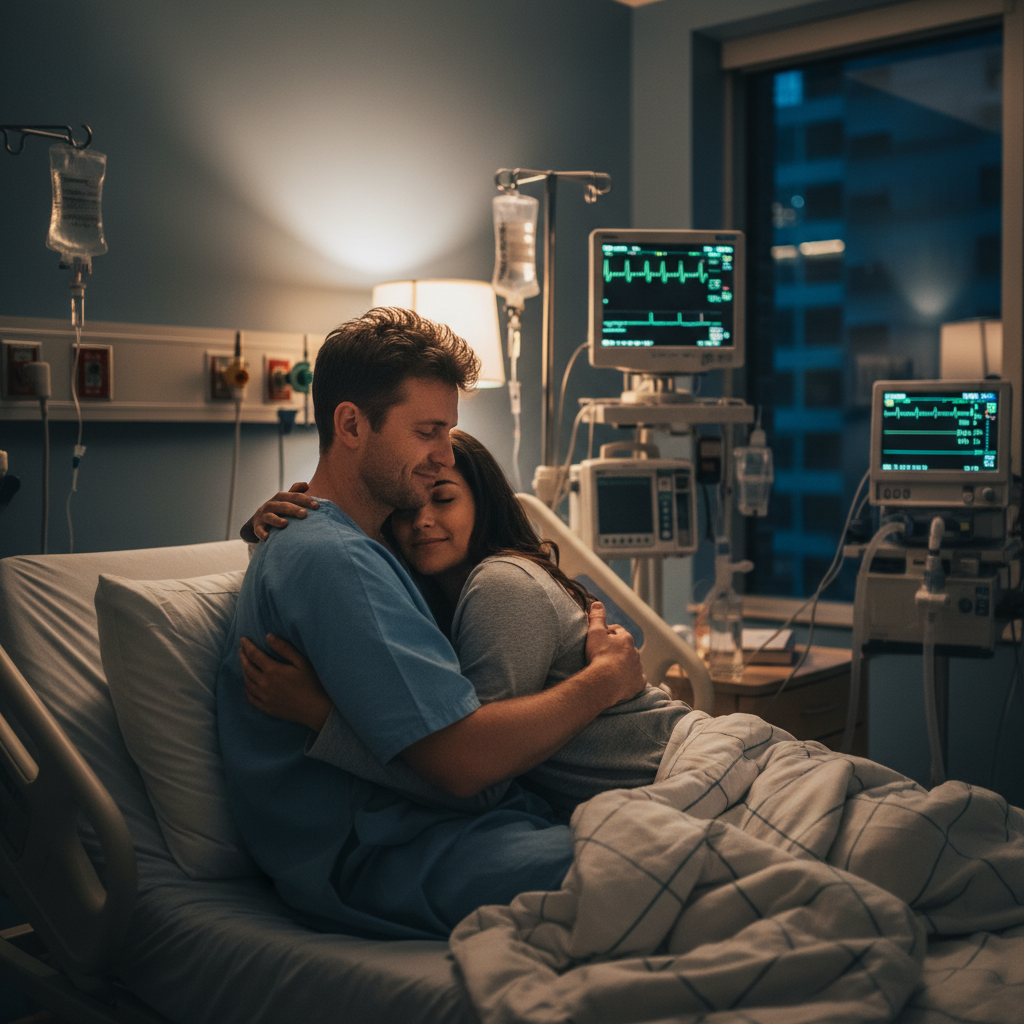
Active labor arrived at 2:17 a.m. on a Tuesday. Amara was 6 centimeters when we arrived at the hospital and stalled there for three hours — the same wall she'd hit the first time. The room had the particular stillness of a place where a decision is about to be made. The attending suggested Pitocin. We asked for twenty minutes first.
We repositioned Amara to a hands-and-knees position on the bed, used a rebozo scarf to shift the baby's position, and worked through four contractions that way. Derek was behind her the entire time, counter-pressure exactly where she needed it, saying the words we'd practiced. At the twenty-minute check, she was 8 centimeters. The Pitocin conversation ended.
"She looked at me and said, 'You know what to do.' And I did. For the first time, I actually did."
— Derek, on the moment labor shifted
Amara pushed for 41 minutes. Her daughter was born at 6:04 a.m. with the first light coming through the blinds. The scar from her first cesarean stayed exactly where it was — a reminder of a different story, not a limitation of this one.
In Their Words
"I didn't think I was allowed to want the birth I wanted. She made me feel like I was allowed to want it — and then she helped me get there. I keep thinking about that room at 6 a.m. I want every woman to have that room."
— Amara, six weeks postpartum
Story Two
Priya & James
Planned home birth · Hospital transfer · First-time parents
The Situation
Priya had done everything right. Prenatal yoga since week twelve. A midwife she adored. A birth pool in the living room, the water kept at 37 degrees. She'd read every book and dismissed every horror story. James had built a playlist. They were ready. What they weren't prepared for was the call at 4 a.m. when the midwife said, quietly and without alarm, that the baby's heart rate was showing a pattern she didn't like and they needed to go to the hospital. Everything they'd planned for dissolved in about ninety seconds.
The Birth Plan
Our birth plan work with Priya and James had included a transfer scenario — not because we expected it, but because informed families make better decisions under pressure. We'd talked through what a hospital environment would look like, what Priya's rights were the moment she walked through those doors, and what questions to ask before any intervention was offered. When the transfer happened, they weren't starting from zero.
"We'd practiced for this exact moment. I didn't know that until we were living it."
The Labor
The hospital was loud in the way hospitals are at 5 a.m. — not dramatically, just persistently. Fluorescent. Institutional. Everything Priya had wanted to avoid. She was 5 centimeters and frightened in a way that had nothing to do with the pain. James was trying to hold her hand and fill out paperwork simultaneously. The midwife, who had come with them, was handling clinical handoff.
We pulled the curtain. We dimmed what we could. We put Priya's playlist on her phone and set it on the windowsill. We told the nursing staff, clearly and without confrontation, that Priya wanted intermittent monitoring where possible and that she'd like to be spoken to directly before any procedure. The nurse — a woman who had clearly seen every kind of birth family — nodded and wrote it down.
"She walked into that hospital room and somehow made it smaller. Not the room — the fear. She made the fear smaller."
— James, two weeks after the birth
Priya labored for four more hours. The baby's heart rate stayed steady. She pushed in a semi-reclined position with James at her left shoulder and delivered without any intervention beyond the initial monitoring. Their son was born at 9:47 a.m. and placed immediately on Priya's chest. She cried. James cried. The nurse cried a little too, which she denied.
In Their Words
"The birth I planned didn't happen. The birth I needed did. I don't think I understood the difference until afterward. She understood it the whole time."
— Priya, three months postpartum
Story Three
Claire & Nate
Second birth · Traumatic first experience · Rewriting the story
The Situation
Claire's first birth was, by any clinical measure, a success. Baby healthy. Mother recovered. Discharge on schedule. But Claire remembered it differently: a room where no one explained what was happening, a provider who spoke past her to Nate, a moment during transition when she asked for help and the nurse said "you're almost there" and walked out. She didn't talk about it for eight months. When she finally did, she used the word "alone." Her second pregnancy came with a decision: this time would be different. She found us through a friend who'd had a similar first birth and a completely different second one.

The Birth Plan
We spent our first session just listening. Not to the pregnancy — to the first birth. Claire needed to tell that story to someone who wouldn't rush to reassure her that it was fine. It wasn't fine. It was survivable, which is different. Once she'd said all of it, we could start building something new.
Her birth plan for the second birth had one sentence at the top, before anything clinical: "Please speak to me directly, not about me." Everything else followed from that. We prepared Nate for how to reinforce this in real time — not confrontationally, but persistently. He had three phrases. He practiced them until they felt natural.
The Labor
Labor was long — 19 hours from first contraction to delivery. There were three moments where the old story tried to repeat itself: a resident who reached for a procedure without asking, a shift change that brought a nurse who hadn't read the birth plan, and a period around hour fourteen where Claire hit a wall and said she couldn't do this. Each time, something held.
"When the resident reached for the IV without asking, I heard Nate say, very calmly, 'Can you explain what you're doing and why?' And she stopped and explained. That had never happened to me before."
— Claire, on hour six
"Around hour fourteen she looked at me and said 'I can't.' I looked at her and said what I'd been told to say: 'You already are.' She cried. And then she kept going."
— Nate, on the turning point
Claire's son was born at 11:23 p.m. The room was quiet in the way that rooms are when something enormous has just happened and everyone in them knows it. The nurse who'd joined at shift change held Claire's hand while she held her baby. Nobody spoke for a while.
In Their Words
"I used to say my first birth was traumatic. Now I say it was the one where I didn't have the right support. This birth — I was seen the entire time. Every contraction. Every decision. Every breath. I have never felt less alone in my life. I didn't know birth could feel like that. I want every woman to know it can."
— Claire, five weeks postpartum